How Pet Insurance Works: Deductibles, Reimbursement & Waiting Periods
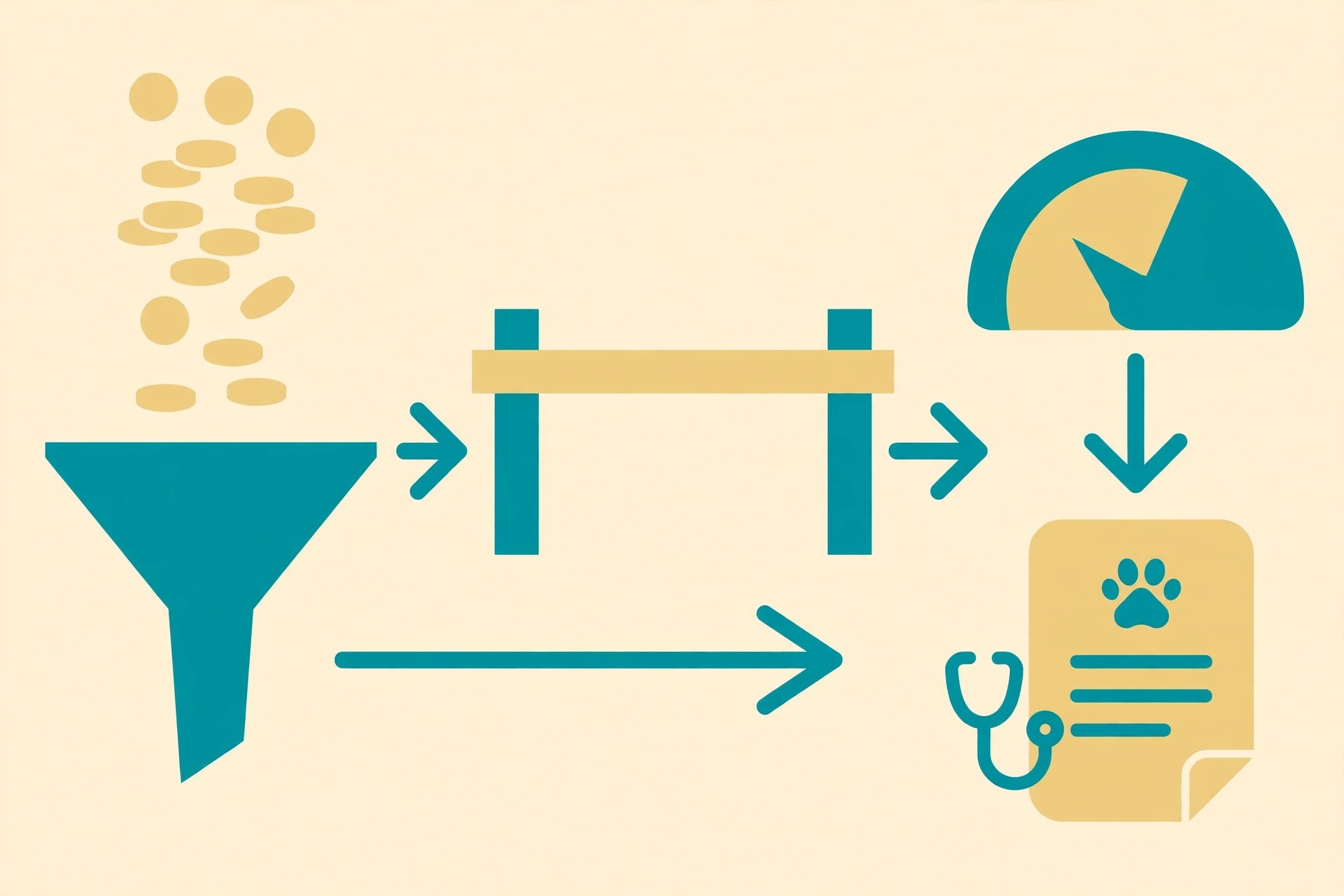
Pet insurance works differently from the health insurance you probably have. The biggest surprise for most people: you pay the vet first, then get reimbursed. There's no "in-network vet" and no card to swipe at the counter. Once you understand that, the rest clicks into place.
The five moving parts
1. The premium
Your monthly payment for the policy itself. Premiums vary widely by pet, breed, age, and provider — a young mixed-breed cat costs very little to insure compared to an older purebred large dog, because the expected vet bills are completely different. Premiums usually rise as your pet ages, since older animals need more care. When you sign up, you choose a deductible, a reimbursement rate, and an annual limit, and those choices move your premium up or down.
2. The deductible
The amount you pay out of pocket before the insurer pays anything. Deductibles come in two flavors:
- Annual deductible: you pay this amount once per policy year, across all claims. Meet it in February, and everything after that is covered (at your reimbursement rate) until the year ends.
- Per-condition deductible: you pay it separately for each condition. Two unrelated illnesses in one year? Two deductibles.
Higher deductible = lower premium, but more out of pocket when something happens. There's no universally right answer; it depends on whether you're insuring against catastrophe or against the steady drip of moderate bills.
3. The reimbursement rate
After you've met your deductible, the insurer pays a percentage of covered costs — commonly 70%, 80%, or 90%. The higher the percentage, the higher the premium. Note this applies to covered costs: if a treatment isn't in the policy, the rate is irrelevant.
4. The annual limit
The maximum the policy will pay out in a year. This is the number that separates "insurance against disaster" from "a discount plan with branding." A low annual limit can leave you exposed exactly when a bill is worst — an emergency surgery plus a hospital stay adds up fast. If your goal is catastrophe protection, the annual limit matters more than almost anything else.
5. Waiting periods
Almost every policy makes you wait a set number of days after enrollment before coverage kicks in — often short for accidents, longer for illnesses, and sometimes much longer for specific conditions like ligament injuries. Anything that happens during the waiting period isn't covered, and if it becomes a diagnosed issue, it can be treated as a pre-existing condition afterward. This is the single most misunderstood part of pet insurance.
How a claim actually flows
- You pay the vet. The full bill, on your card, at the appointment.
- You file a claim. Usually through an app or portal: the invoice, and sometimes the medical notes. Most providers let you do this from your phone in a few minutes.
- The insurer reviews it. They check the policy terms, the waiting periods, whether the condition is covered, and whether the deductible has been met.
- You get reimbursed. The covered amount at your reimbursement rate, minus the deductible, up to your annual limit. This typically takes days to a couple of weeks depending on the provider.
The pre-existing condition rule
Most policies exclude pre-existing conditions — anything your pet showed symptoms of, or was diagnosed with, before coverage started (including during waiting periods). Some insurers distinguish between curable conditions (like an ear infection that fully resolved) and chronic ones (like diabetes), and a few will cover curable conditions after a symptom-free stretch of time. The details live in the fine print of each policy, and they differ a lot between providers.
Ready for the next piece? See what pet insurance covers — and what it doesn't.